
This week we were tasked with reviewing our critical reflection thus far and improving upon it using the framework of the five reflective domains (Parker, 2021):
Dispositional domain – Time management, motivation, general behaviour and discipline
Affective domain – Feelings, experiences and emotions
Interpersonal domain – Interacting with others, Verbal/Non-verbal communication, listening negotiating, problem-solving, decision-making and assertiveness
Cognitive domain – The strengths and weakness of my approach to learning
Procedural domain – Learning by doing, failing and reflecting against my existing skillset
We were given the task of reviewing our existing CRJ entries and assessing the distribution of our reflection across the 5 areas.
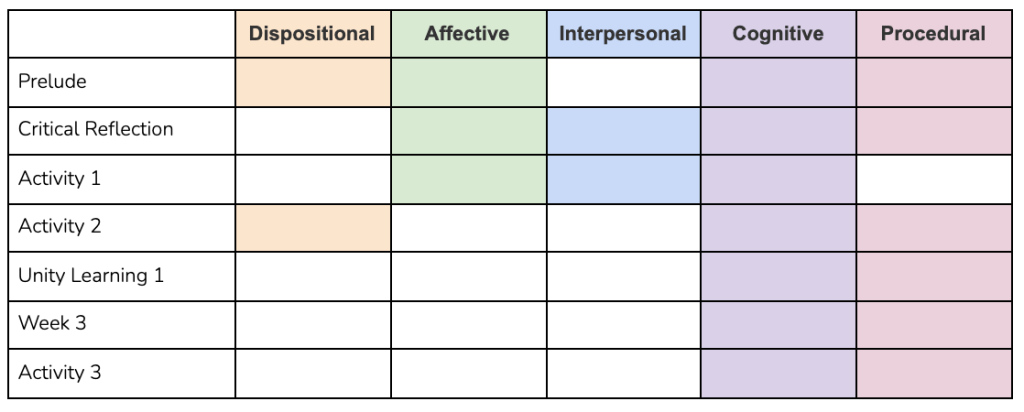
It is clear that I am paying attention to the learning and academic aspects of my reflective practice and less to the dispositional, affective and interpersonal. As a naturally emotional person this was a surprise to me and I expected that the feeling aspects would be the highest. I also noticed that as the course has progressed and I have been more pressed for time the problem has become more prevalent. Our module tutors Giovanni and Gareth noted in a recent webinar that focussing on a description of the learning is often a mistake new learners make and so this in combination with the exercise has become a critical incident for me.
Reflecting on why this may have happened, I believe there are a number of factors at play. Firstly, as academic writing is relatively new to me I have been focused on what I have been learning through doing as opposed to reflecting on the holistic experience. I think this is because it the easiest thing to grasp and i’m probably trying to prove to myself and everyone else that i’ve “done my homework”. Secondly, having spent some time in education, the process of learning is a space I am a little more used to writing about. Lastly, as I noted in an earlier journal entry on reflection, I have a leaning more towards process and learnings gained from others and away from those gained through introspection. Turning inwards for insights based on my own experiences isn’t a place where I would naturally search for value.
After making these observations, I set some goals for myself to address them following the SMART framework first created by George Doran in 1981. The words within the acronym have changed over time but the core intention remains the same; encouraging those setting goals to set them clearly and with intention. The version I have used suggests the following criteria.
S – Specific
M – Measurable
A – Achievable
R – Relevant
T – Time-bound
As with all frameworks, it will be important for my to apply this mindfully rather than blindly. As Doran explains; ‘It should also be understood that the suggested acronym doesn’t mean that every objective written will have all five criteria.
‘ (1981: 36)
As such, the goals I have set are as follows;
Goal 1: I will intentionally consider each of the Five Reflective Domains in each of my CRJ entries from Week 6 onwards.
Goal 2: I will create a framework which I will use to create my CRJ entries from Week 6 onwards.
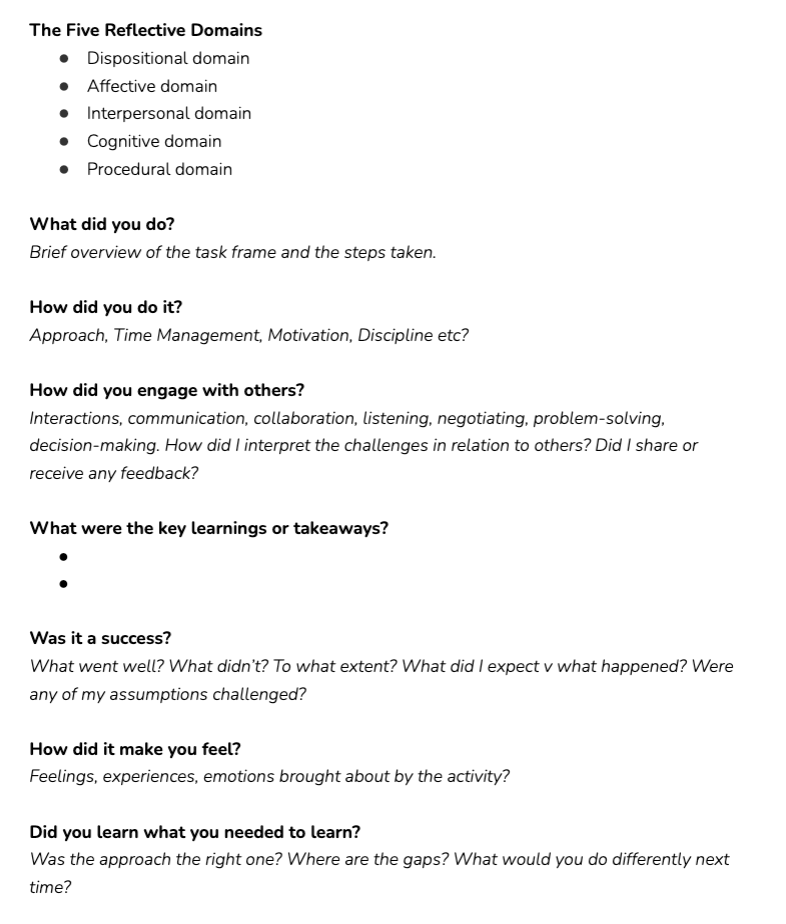
I have since created a template tool that I will use to structure my journal entries, by using prompt questions to cover each area. I also used comments made by my peers and tutors in this week’s forum thread to help shape it. It is my hope that by consciously practicing, I will be able to develop my critical reflection skills in a more balanced and holistic way.
References
PARKER, Alcwyn. 2021. ‘Week 5: The Five Reflective Domains’ . Falmouth University Canvas. [online] Available at: https://learn.falmouth.ac.uk/courses/240/pages/week-5-the-five-reflective-domains?module_item_id=9166 %5Baccessed 28th October 2021]
DORAN, George. T. 1981. “There’s a S.M.A.R.T. Way to Write Management’s Goals and Objectives”, Management Review, 70(11), 35-36. [online] Available at: https://community.mis.temple.edu/mis0855002fall2015/files/2015/10/S.M.A.R.T-Way-Management-Review.pdf [accessed 23rd December 2021]
Full list of figures
Figure 1: CRJ Reflective Domain Analysis. 2021. Screenshot of a diagram by the author.
Figure 2: CRJ Reflective Domain Analysis. Screenshot of a document by the author.
 morwennagriffin.com
You must be logged in to post a comment.