
Week 4 and 5 are dedicated to our first rapid ideation sprint. The goal is to produce an interactive artefact within the timeframe, to a loose theme set by a visual creative prompt. As a prompt, we were given a card from the game Dixit, showing a dragon and a figure holding a sword.

After a search for positive news, I found an article about running and how it makes people happy that I decided to introduce as a diversifier:

I wanted to take this ideation sprint as an opportunity to develop my practical games production skills. Although it made me nervous, I also felt excited at the prospect of producing something tangible so early in the course. The development of games-focussed technical skills is a key goal for me during the course and where I feel I need to develop the most in comparison to my peers.
I decided to cement some of my earlier course learnings and utilise the ideation techniques we reviewed in my planning. I was anxious about producing something in the timeframe, so I set out to create and follow a small project plan to keep myself on track.
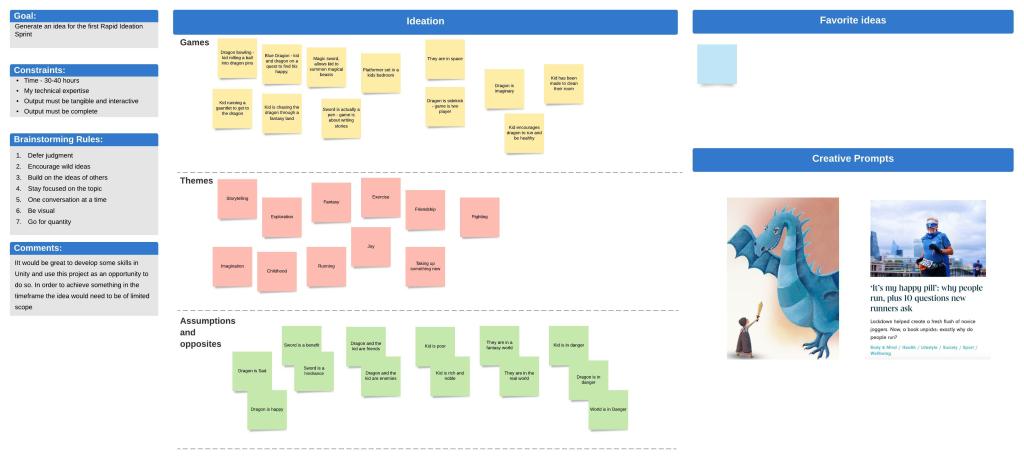
I started by brainstorming on game types, themes and using opposite thinking to generate narrative ideas.
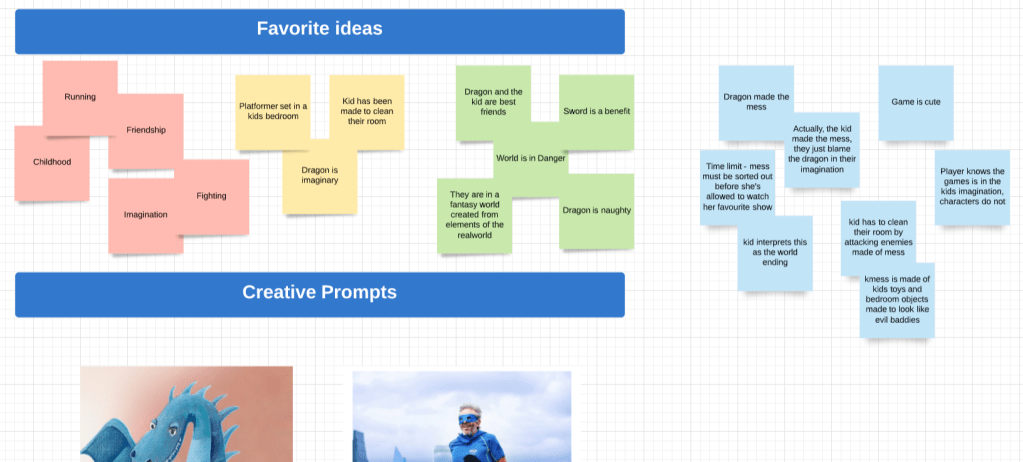
Next, I grouped my favourite post-its to create some cohesive ideas and built on top of these:
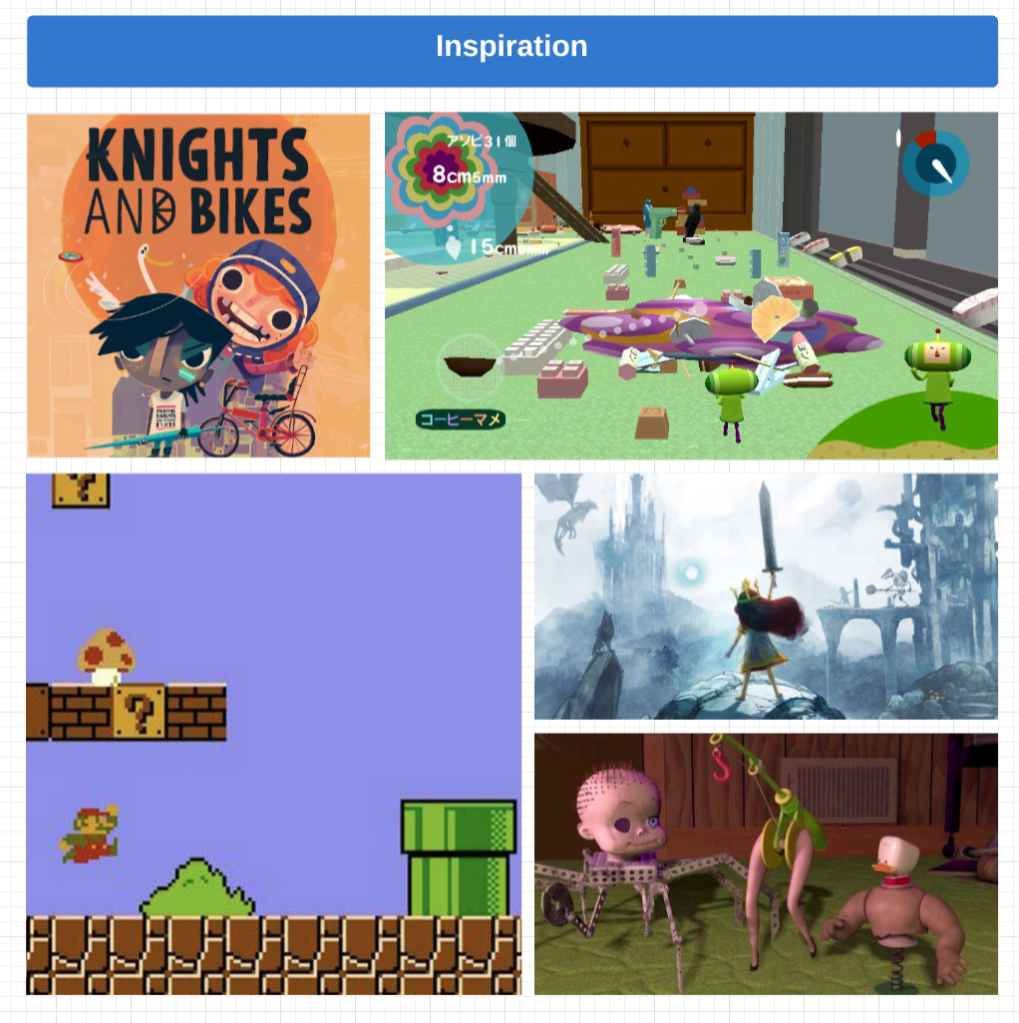
I then wrote a narrative premise and looked for some inspiration from other games in terms of their look and feel:
“It is a Saturday afternoon and at this time every week, Alex travels through the rectangular Sky portal to meet with a band of intrepid heroes known as the Mega Knights. The Mega Knights are on an incredible adventure through time and space, and Alex has been with them every step of the way (just in case they should need him). The fate of the world is at stake.“
“But, this week… there’s a problem. Alex’s room is messy. Not just a little bit messy, but the messiest mess that anyone has ever messed. Until the room has been vanquished, the evil Lord Dad will not allow Alex to reunite with the Mega Knights. “
“The thing is, it’s not Alex’s fault… a dragon did it – Jessie. If only Lord Dad would listen! (It’s not really Jessie’s fault either – they’re just a bit untidy, as dragons tend to be.) Time is short, but with Jessie at his side Alex will take on this powerful foe the only way he knows how: with the heart and might of a Mega Knight.” (Griffin 2021)
Once I had my narrative I set out the elements I needed to make the game and then boiled each of those down to an MVP following the guidance of Eric Ries, author of ‘The Lean Startup:
As you consider building your own minimum viable product, let this simple rule suffice: remove any feature, process, or effort that does not contribute directly to the learning you seek.
(2004)
I then created a small project plan detailing how long I intended to spend on each element and began work.
I created the assets and then attempted to build it in Unity using the 2D template but struggled. Whilst I would have preferred to use Unity, the learning curve for a sprint so short was too steep. After a number of frustrated hours I decided to cut my losses and look for relevant tutorials in Game Maker Studio 2 to follow and adapt to my needs as I moved through the sprint. I was advised by a peer to try this as a simpler tool for beginners.
I remediated upon a series of Youtube tutorials created by Shaun Spalding and adapted them as I developed. The combination of visual and audio worked really well for me as a learner and is something I would repeat while my skills are limited. I also had a session with my mentor who shared guidance on debugging and walked through the project with me.
Here is what I produced:
I was relatively happy with what I achieved, but even having created an MVP outline I was still too ambitious in terms of scope. Despite my planning, I was unable to complete what I set out to in the timeframe.
My key learnings and takeaways are as follows;
Make sure my MVP really is just that
When working with time constraints, it is critical to strip away anything that is unnecessary to focus on what is the core of the product or experience. It is easy to add in additional features or content down the line, but it is much more difficult to strip them out. On reflection, I didn’t do this very well in this task and still took on too much work given the stage I am at with my technical skills. The result was that I ended up with something that was incomplete. Next time I will create an MVP, reflect and then strip it a second time in order to give myself the best chance of completing everything I set out to.
Technical learnings
I learned some basics in Game Maker and some code to create a scene, player movement and animations. In going through this process I learned about tunnelling and the importance of the order of operations in code. This sprint showed me the importance of my mentor relationship and their experience. Having someone to talk about my progress and challenges with was invaluable.
Focussing my time intentionally
Although I am not an artist, art and design are where i am most comfortable in this context. In this sprint, I managed to produce something that looked and felt something like what I had imagined but lacked in gameplay and mechanics. In the next session I will focus as much time as possible on trying to create something that plays as I would like it to. It is natural to want to lean into my existing strengths and seek comfort there, but I need to push away from that in order to develop.
References
GRIFFIN, Morwenna. 2021. Mega Knights. Unpublished.
RIES, Eric. 2011. The Lean Startup. New York: Penguin Random House.
SPALDING, Shaun. 2017. GameMaker Studio 2 – Complete Platformer [tutorial series]. Shaun Spalding Youtube Channel [online]. Available at: youtube.com/playlist?list=PLPRT_JORnIupqWsjRpJZjG07N01Wsw_GJ [accessed 15th October 2021]
Full list of figures
Figure 1: Marie CARDOUAT. 2008. Dixit Card. Dixit. Libellud.
Figure 2: Neil BRADSHAW. 2021. From: ‘‘It’s my happy pill’: why people run, plus 10 questions new runners ask’. Positive News [online]. Available at: https://www.positive.news/lifestyle/its-my-happy-pill-why-people-run-plus-10-questions-new-runners-ask/. [accessed 14th October 2021]
Figure 3: Morwenna GRIFFIN 2021. Game Brainstorm #1: Lucid Chart [screenshot by author]
Figure 4: Morwenna GRIFFIN 2021. Game Brainstorm #2: Lucid Chart [screenshot by author]
Figure 5: Morwenna GRIFFIN 2021. Game Brainstorm #3: Lucid Chart [screenshot by author]
Figure 6: Morwenna GRIFFIN, Morwenna. 2021. Rapid Ideation 1: Mega Knights. Morwenna Solange Youtube Channel [online]. https://www.youtube.com/watch?v=LvHoB7TIt3s [accessed 27th October 2021]
 morwennagriffin.com
You must be logged in to post a comment.