
This week we are exploring ‘Time and Project Management’ alongside the start of our first rapid ideation sprint. A timely topic indeed with more competing priorities coming my way!
As time is short, I have decided to limit my research to improving my own practice and considering how it might apply to my career.
I trialled a technique recommended by my tutor Gareth in order to stay focussed on producing high quality content in the shortest timeframe: the Pomodoro technique.
Pomodoro aligns with Agile principles and seeks to maximise productivity by working intensively on single tasks in bursts of 25 minutes (Cirillo 2007).
Typically I have a short attention span and already work in flow-like bursts. During the pre-course support screening, my results indicated strong tendencies towards ADHD; a connection I have never previously made. I also have a job that is often reactive and prone to interruptions, so I was excited to try out this new way of working.
As I anticipated, in the beginning the hardest things to manage were external interruptions and my own concentration. The more I practiced, the more my family became accustomed to leaving me alone during Pomodoros and the better I became at it. During the course of the exercise I also realised i’m addicted to the Dopamine hit I get from my mobile phone (Sinek 2014) and found myself subconsciously reaching for my device on a horrifyingly frequent basis. I am now consciously looking for this behaviour in a bid to break the habit. For instance, in this case I found a series of Pomodoro Youtube videos made by the creator Gibi ASMR (2019) and played them alongside my working. Every time I reach for my phone, there is now a mental trigger to make me stop.
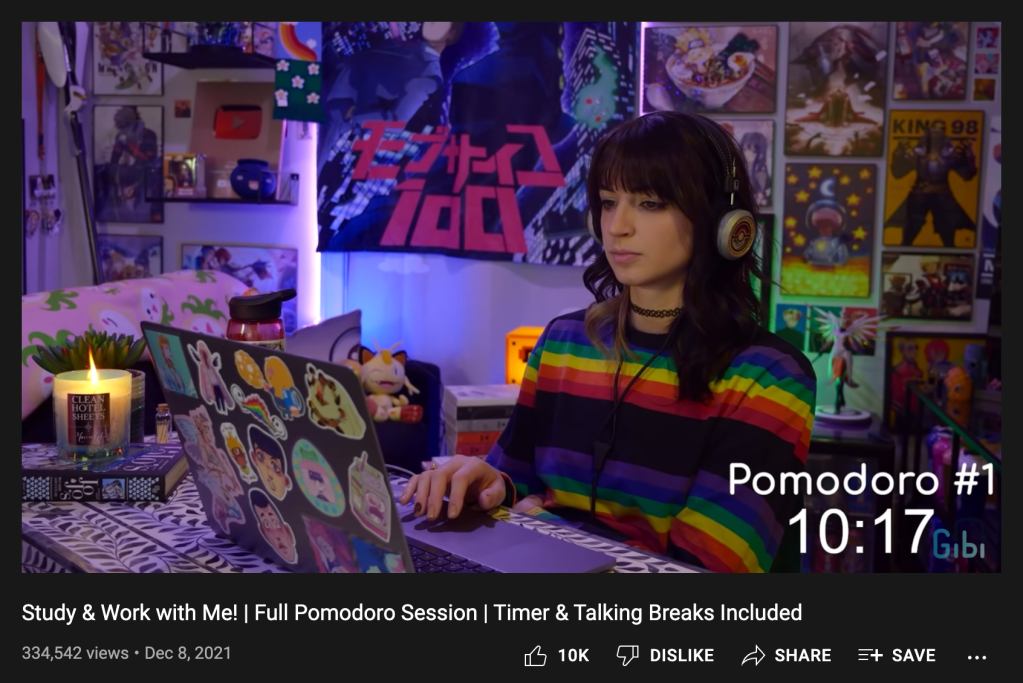
The results were great; allowing me to maintain concentration and motivation for longer. I will definitely continue to use this technique in my studies and also in my work life.
This week I also set up my first Rapid Ideation sprint and have been thinking about the various time and project management tools in my academic and professional work.
I chose to plan this sprint using a simple combination of Kanban and Waterfall due to the time constraints and project simplicity. Over the course of this module I have also started using physical Kanban boards. I get satisfaction from moving and completing tasks – Dopamine at it again! (Sinek 2014) – and have seen this work very successfully in the first games studio I worked in and also in my role at MakerClub. I also like to physically write my lists down and have always felt that making goals and tasks physical made me more likely to achieve them. It has been widely hypothesised that this improves productivity on the basis of external storage and encoding as with note-taking (Friedman and Rickards 1978). However this week I was surprised to learn that there isn’t actually much in the way of peer reviewed research to support this, and those that I read were all unsuccessful in their attempts to prove this hypothesis.
Most professional projects I work on currently are relatively short with small working groups and so I have found Trello to be the most simple and user friendly for this kind of work in comparison to other systems like Wrike or Jira. However, these more heavyweight tools have been better for complex production projects with lots of interdependencies. I am looking forward to working on some projects of this kind and investigating integration with other systems like version control.
I also took some time this week to further delve into the role of the producer. I have realised that I tend to step into this role naturally on projects i’m involved in; generally taking the reins on planning and ensuring things get done on time. Through this research I have started to become interested in the role of the Executive Producer – moving more into the production space while utilising the skills I have developed in business strategy, leadership and management.
References
CIRILLO, Francesco. 2007. The pomodoro technique. [on-line] Available at: http://www.baomee.info/pdf/technique/1.pdf [accessed 26th December 2021]
FRIEDMAN, Frank and John P. RICKARDS. 1978. ‘The encoding versus the
external storage hypothesis in note taking’. Contemporary Educational
Psychology. 3(2) 136-143. [online] Available at https://doi.org/10.1016/0361-476X(78)90020-6 %5Baccessed 23rd December 2021]
GIBI ASMR. 2019. ‘Study and Work with Me!’. YouTube [online]. Available at: https://www.youtube.com/watch?v=jMQAdBICc7Y [Accessed 26th December 2021].
SINEK, Simon. 2016. ‘Addiction to Technology is Ruining Lives.’ Inside Quest [online]. Available at: https://www.youtube.com/watch?v=sL8AsaEJDdo [Accessed 26th December 2021].
SINEK, Simon. 2014. Leaders Eat Last. New York: Penguin.
WEINBERG, Robert. 2010. ‘Making Goals Effective: A Primer for Coaches’. Journal of Sport Psychology in Action. 1(2) 57-65
Full list of figures
Figure 1: Francesco CIRILLO. 2007. The Pomodoro Technique [online]. Available at: https://www.amazon.co.uk/Pomodoro-Technique-Francesco-Cirillo/dp/1445219948 [Accessed 26th December 2021].
Figure 2: Gibi ASMR. 2019. ‘Study and Work with Me!’ [screenshot] YouTube [online]. Available at: https://www.youtube.com/watch?v=jMQAdBICc7Y [Accessed 26th December 2021].
 morwennagriffin.com
You must be logged in to post a comment.